
Collioure, France — 2007
A documented photographic project on memory, dignity, and the living history of a Catalan village.
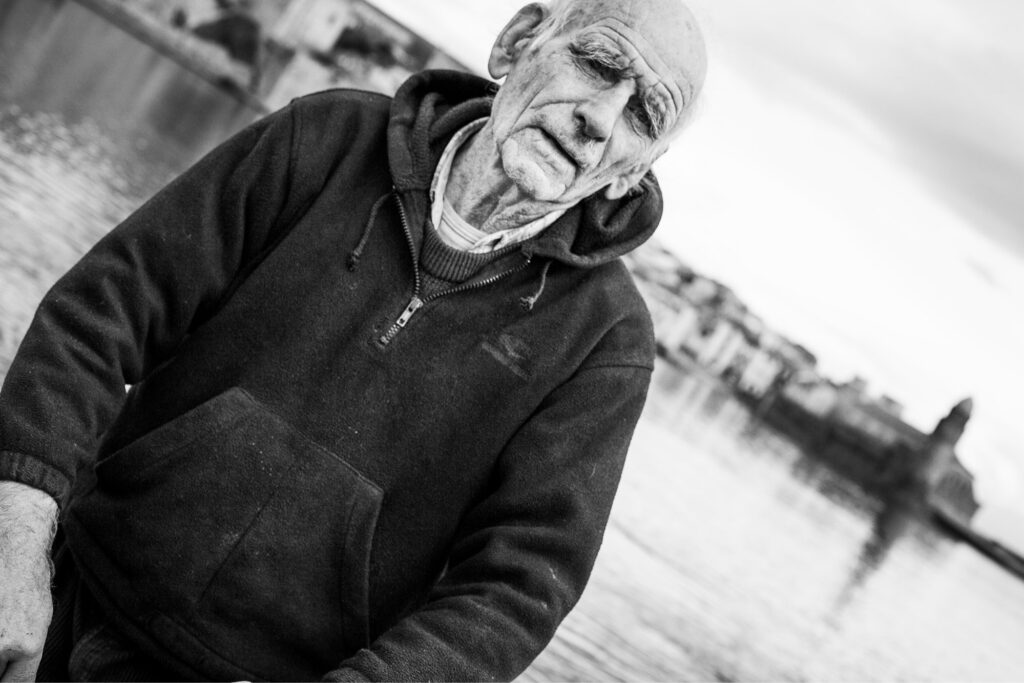
Mateu, known in Collioure as the last fisherman, photographed from his boat with the village port and church behind him.
In 2007, I created and exhibited The Elders of Collioure, a monochrome portrait project devoted to the oldest residents of Collioure, a Catalan village on the southern coast of France.
The work was first presented at the Mairie of Collioure, where the mayor introduced the collection to residents of the city. It was later exhibited publicly for three months at the Galerie de l’Ancienne Mairie, the city’s cultural center, during the summer season of June, July, and August.
The project was also featured in L’Indépendant on April 23, 2007, under the headline Les anciens dans le viseur de Jérôme Scullino — “The elders in Jérôme Scullino’s viewfinder.” The article documented the exhibition and recognized the work as a series of portraits of the village’s elders, including Madeleine Ramonet, the doyenne of Collioure, who had recently celebrated her 105th birthday.
Collioure holds an important place in art history. It is the village where Henri Matisse and André Derain encountered the light that helped give birth to Fauvism. But I had not come in search of colour. I had come in search of faces.
With the help of my aunt, Marie-Françoise, who knew the village, its families, and its stories, I began looking for residents aged eighty-five and older. We asked a simple question:
Who are the forgotten heroes of Collioure?
What followed became less a photographic assignment than a pilgrimage. Behind each door was a living archive: fishermen, artisans, mothers, widows, men and women who had lived through war, peace, family, loss, and the slow transformation of a village they had known all their lives.
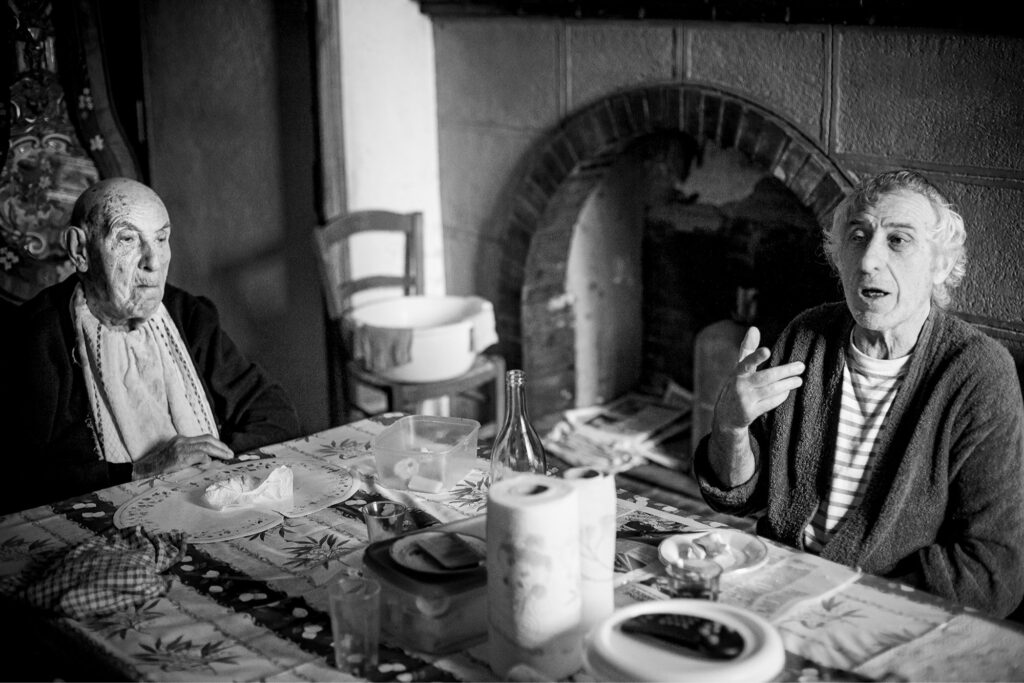
A father, 91, and his son, 75, photographed at home during lunch in Collioure.
At the time, I had already worked as a photographer for more than a decade. But in Collioure, something changed. I began to understand that the subject of my work was not scenery, performance, or beauty in the conventional sense. It was presence.
The portraits were made in monochrome because colour would have said too much. I wanted the images to stay close to the truth of skin, gesture, posture, light, and time. Without distraction, the faces revealed what I was beginning to search for in all my work: the moment when a person allows themselves to be seen.
Mateu, the Last Fisherman
One man in particular stayed with me.
His name was Mateu.
In the village, people spoke of him as a legend: the last fisherman, a man known and admired, even featured on French television. But the legend surrounding him had also created distance. People warned me that he kept to himself and might not welcome me.
When I found my way to his home and knocked, Mateu opened the door.
He welcomed me in.
Over the following days, we spent time together. He invited me to go fishing with him, something I later learned was almost unheard of. In that time, I began to understand that the village’s idea of him had become larger than the man himself. Even his own family had stopped reaching out, perhaps unsure of how to cross the space that had grown around him.
I asked why he did not take his granddaughter and great-granddaughter out to sea.
“They never ask,” he said.
So I asked.
That outing became the beginning of a renewed connection between them.
This is what portraiture can do at its deepest level. It can make a person visible again — not as an idea, not as a role, not as a legend, but as a human being.
A Turning Point
The Elders of Collioure became a turning point in my life and work. It taught me that a portrait is not only an image. It is an encounter. It can preserve a face, but it can also restore a relationship, reopen a door, and affirm the dignity of a life that might otherwise pass unnoticed.
Years later, this understanding followed me into the studio. I began to see that the same intimacy I found in village homes and narrow streets could happen under controlled light, in a deliberate space. The studio did not diminish the truth of the encounter. It refined it.
Today, whether I am photographing a family, a mother, a public figure, or someone who has never felt comfortable in front of a camera, I return to what Collioure taught me:
Every person carries a story worthy of reverence.
Every face holds more than appearance.
And sometimes, the work begins with something as simple as paying attention long enough for someone to be seen.
Collioure may have been where Matisse discovered colour.
It is where I discovered my voice.
Press & Exhibition
The Elders of Collioure was first presented in 2007 at the Mairie of Collioure, where the mayor introduced the collection to residents of the city. The project was then exhibited publicly at the Galerie de l’Ancienne Mairie, the city’s cultural center, for three months during the summer season — June, July, and August.
The project was also featured in L’Indépendant on April 23, 2007, under the headline Les anciens dans le viseur de Jérôme Scullino. The article documented the presentation of the portraits and the project’s tribute to the village’s oldest residents, including Madeleine Ramonet, the doyenne of Collioure, who had recently celebrated her 105th birthday.
